Follow'2'Print Hybrid
Mercury Cloud Server MCS
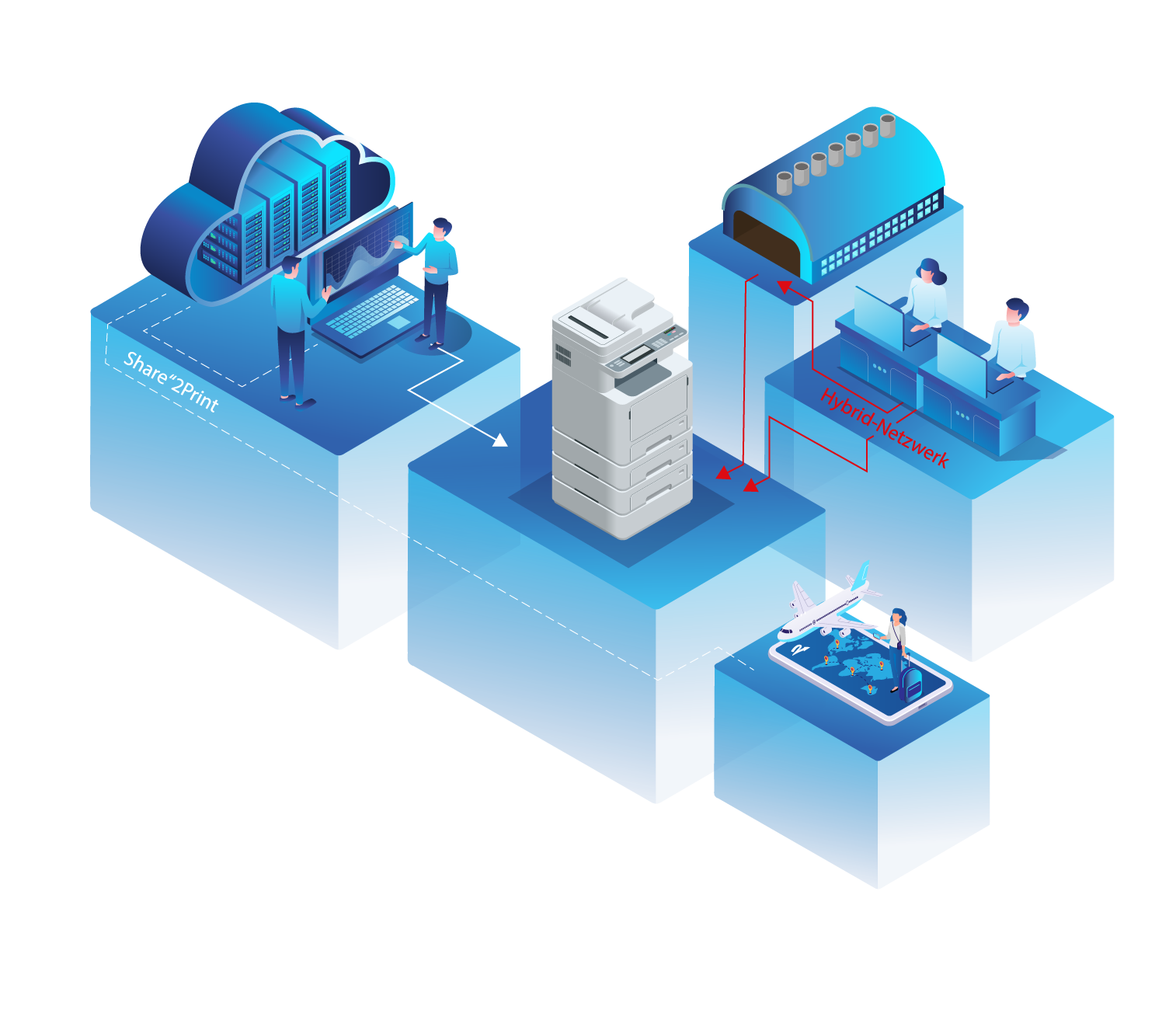
MCS takes over central control of the entire printing environment: user management, printer assignments, permissions, predefined print profiles, and workstation configurations. Configuration is conveniently carried out from the cloud—regardless of location. MCS is operated by docuFORM in a German data center and provided as part of a Software-as-a-Service (SaaS) model.
MCS communication takes place via secure protocols (OAuth2, REST API, MQTT via port 443).
Direct print serverless
The Global Printer Client (GPC) is installed on every Windows workstation and creates print-ready data suitable for the respective output system. It automatically detects the available printers, makes them available to the user, and sends the print job—either directly to the printer or for later pickup.
Follow'2'Print Hybrid
Print data is no longer only stored on the endpoint device but, depending on user needs, also stored in the local GPC storage - regardless of the workstation PC status. This means Follow'2'Print jobs can be retrieved even when the original device is offline.
Print release is done via multifunction devices with user/password, smartcard (RFID), or the mobile app. After login, the user receives an overview of stored jobs - regardless of which device the job was created on.
Mobile App
Thanks to central storage, smartphones worldwide and macOS devices can also send print jobs to the Mercury solution. The data is automatically processed in the hybrid architecture and is available at every authorized printer.
Benefits at a glance:
- Central cloud administration: Users, devices, and print profiles are efficiently managed in the MCS.
- Full control over print data: Print jobs always remain in the corporate network - maximum data security.
- Device independence: Print jobs can be retrieved at any time - even when the original workstation PC is turned off.
- Seamless mobile and Mac integration: Support for mobile print & macOS available.
- Flexible scalability: Ideal for companies with home office, multiple locations, or temporary workstations.
- Easy switching: The transition from on-premises or serverless to hybrid architecture is straightforward and possible without data migration.